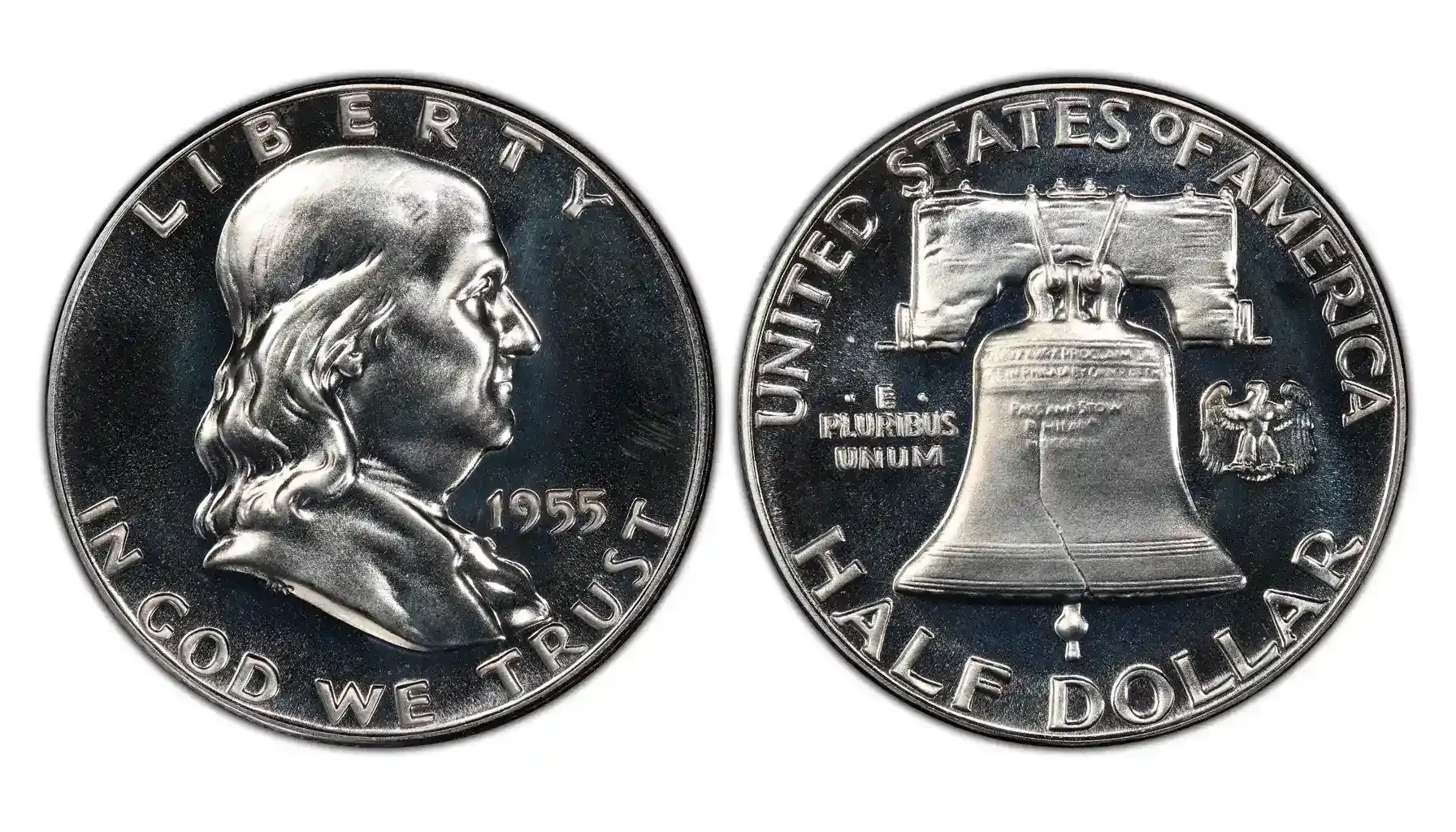
The 1955 Franklin Half Dollar Value Guide

An MS-67 Full Bell Lines specimen sold for $14,100 at Heritage Auctions — yet most circulated examples are worth closer to $20. The gap is defined by the Bugs Bunny variety, Full Bell Lines, and grade. This free guide — with live calculator — tells you exactly where your coin lands.

★★★★★ 4.8 · Trusted by 1,243 collectors
Check My 1955 Half Dollar Value →
1955 Franklin Half Dollar obverse and reverse in high mint state showing full bell lines
$14,100 Top auction record (MS-67 FBL, Heritage 2016)
2.5M Business-strike mintage — lowest in Franklin series
90% Silver content — 0.36 troy oz per coin
1–2% Estimated Bugs Bunny FS-401 incidence in mintage

1955 Franklin Half Dollar Value Chart at a Glance

For a thorough step-by-step 1955 half dollar identification and value breakdown, consult that guide before using the chart below. Values here are based on PCGS and Heritage auction data and reflect the coin's condition, variety, and any special designation.

Variety Worn (G–VF) Circulated (EF–AU) Uncirculated (MS-63–64) Gem (MS-65+)
Regular Strike (no FBL) $18 – $25 $25 – $45 $35 – $70 $80 – $200
⭐ Bugs Bunny FS-401 (no FBL) $20 – $30 $30 – $55 $50 – $130 $400 – $1,950
Full Bell Lines (FBL) N/A $35 – $60 $55 – $120 $150 – $4,950
🔥 Bugs Bunny FBL (FS-401 FBL) N/A $40 – $80 $80 – $200 $625 – $5,000+
Clashed Die FS-403 $20 – $30 $30 – $55 $45 – $90 $100 – $500
Proof (PR-65) — (not circulated) — $90 – $110 $120 – $300+

📱 CoinKnow lets you snap a photo of your 1955 Franklin Half and cross-check its condition tier against certified examples in seconds — a coin identifier and value app.

Jump to Any Section

The Valuable 1955 Franklin Half Dollar Errors — Complete Guide

The 1955 Philadelphia Mint run produced several distinct die varieties and errors that command meaningful premiums over a regular business strike. Understanding what each variety looks like — and where the diagnostic features are — is the difference between spending $40 and spending $400 on the right coin. The four varieties below cover the spectrum from common die clashes to conditionally rare planchet errors.

1955 Franklin Half Dollar Bugs Bunny FS-401 variety showing die clash spike at Franklin's upper lip
Most Famous $20 – $5,000+

1955 "Bugs Bunny" Die Clash — FS-401

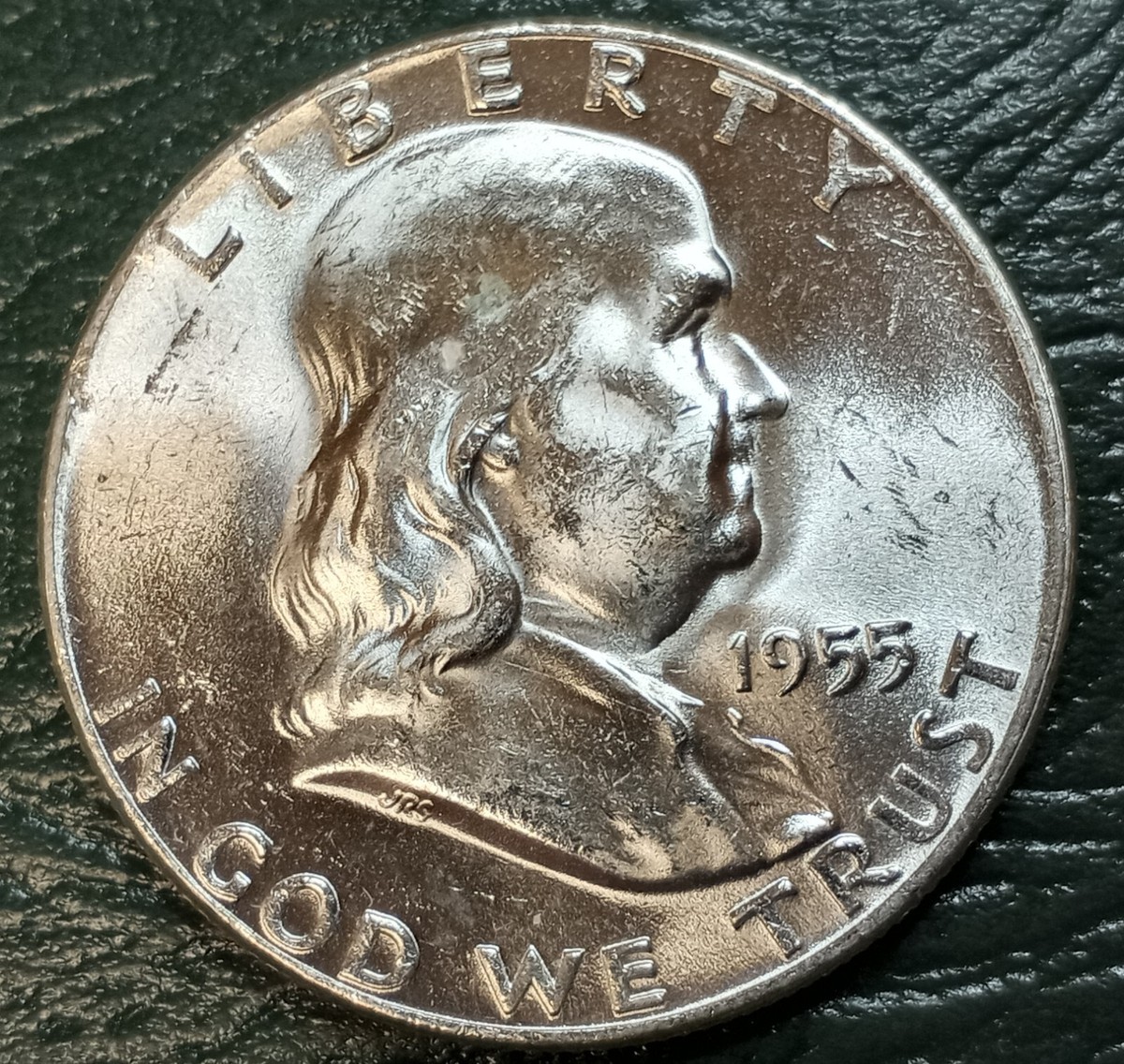
The Bugs Bunny variety is the most celebrated die clash in the entire Franklin Half Dollar series. It occurred when the obverse and reverse dies struck each other without a planchet between them, a mishap that transferred a raised impression of the eagle's wing feather tips onto the obverse die at Franklin's mouth.

The result is a small raised spike or line projecting outward from Franklin's upper lip, giving the portrait the uncanny appearance of buck teeth — hence the "Bugs Bunny" nickname. On strong examples, the clash line is visible to the naked eye; magnification with a 5× or 10× loupe confirms even subtle strikes.

Collector demand is robust because this is one of the most visually striking and photogenic die-clash varieties in U.S. numismatics. The combination with a Full Bell Lines designation pushes values into four figures, with premium MS-66 FBL examples documented at $1,500–$5,000 at Heritage and GreatCollections. PCGS designates this as FS-401 on certified holders.

How to spot it

Examine Franklin's upper lip with a 10× loupe. Look for a small raised line or spike projecting outward from the lip, mimicking protruding buck teeth. Visible to the naked eye on strong clashes.

Mint mark

No mint mark — Philadelphia Mint only. 1955 is exclusively a Philadelphia issue for business strikes.

Notable

Designated FS-401 by PCGS. Estimated 1–2% of the 2,498,181 mintage shows this clash. MS-66 FBL examples have realized $1,500–$5,000 at Heritage and GreatCollections auctions.

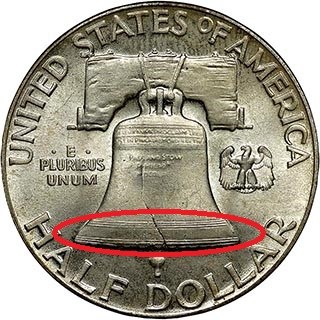
1955 Franklin Half Dollar Full Bell Lines close-up showing complete unbroken horizontal lines at base of Liberty Bell
Most Valuable $55 – $14,100

1955 Full Bell Lines (FBL) Designation

Full Bell Lines is not an error in the traditional sense — it is a premium strike designation awarded when the Liberty Bell's lower horizontal lines on the reverse are fully struck and unbroken from rim to rim. Because the master die used from 1955 onward was worn, achieving FBL on a 1955 coin required exceptionally fresh working dies and a well-centered, heavy strike.

The diagnostic inspection focuses on the two rows of horizontal lines below the bell's crack. Under a 10× loupe, every line must run continuously across the full width of the bell without a break or gap. A single interruption — whether from a die deficiency or a bag mark landing on those lines — disqualifies the FBL designation.

The scarcity of FBL strikes from this date elevates the value substantially. PCGS has certified the 1955 FBL (PCGS #86670) with an auction record of $14,100 at Heritage Auctions in January 2016 for an MS-67 FBL specimen — the highest recorded sale for any 1955 Franklin Half Dollar. MS-65 FBL pieces routinely bring $150–$400, and MS-66 FBL examples sell for $400–$900 at recent auctions.

How to spot it

On the reverse, inspect the lower two rows of horizontal lines on the Liberty Bell with a 10× loupe. All lines must be complete and unbroken edge to edge. One break disqualifies FBL status.

Mint mark

No mint mark — Philadelphia Mint only. The FBL designation applies only to business strikes, not proofs.

Notable

PCGS #86670. Auction record: $14,100 for MS-67 FBL at Heritage Auctions, January 2016. MS-66 FBL examples averaged $400–$900 in 2023 Heritage and Stacks Bowers sales.

1955 Franklin Half Dollar Clashed Die FS-403 variety showing ghost impression of reverse design on obverse fields
Best Kept Secret $22 – $1,500

1955 Clashed Die — FS-403

The FS-403 is a separate die clash variety from the famous Bugs Bunny FS-401, arising from a different clash event at the Philadelphia Mint in 1955. In this case, the die clash transferred elements between the obverse and reverse dies in areas other than Franklin's mouth, leaving faint ghost impressions of the eagle's design in the open fields of the obverse, and/or traces of Franklin's portrait on the reverse fields near the bell.

Identifying FS-403 requires careful examination of the field areas under oblique lighting — tilt the coin so a single light source rakes across the surface. You will notice faint raised outlines or ridges that correspond to design elements from the opposite die. On the obverse, look for ghost impressions of the eagle's tail feathers in the field below the date; on the reverse, watch for traces of Franklin's shoulder near the bell.

While less famous than the Bugs Bunny, FS-403 appeals to specialists who focus on die variety collecting within the Franklin series. In circulated grades, the premium over a regular strike is modest — roughly $5–$10. In gem uncirculated, a well-preserved FS-403 with visible clash marks can reach $500–$1,500, particularly with an FBL designation layered on top.

How to spot it

Tilt the coin under a single raking light source and examine the obverse fields below the date and near Franklin's shoulder. Look for faint raised outlines from the eagle reverse die transferred to the obverse.

Mint mark

No mint mark — Philadelphia Mint only. This variety is exclusive to the 1955 Philadelphia business-strike issue.

Notable

Designated FS-403 by PCGS. Greysheet CPG lists values between $22 and $1,500 for MS examples. Distinct from FS-401; some coins show evidence of both clash events simultaneously.

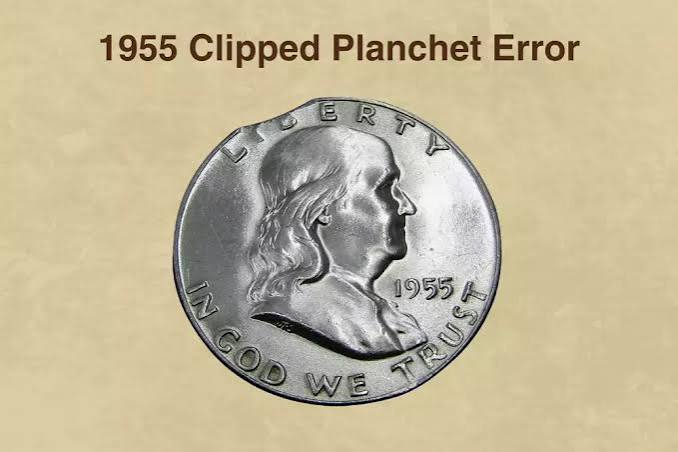
1955 Franklin Half Dollar curved clip planchet error showing crescent-shaped missing section at coin edge
Rarest $75 – $400+

1955 Curved Clip Planchet Error

A curved clip error occurs during planchet preparation — before the coin blank ever reaches the striking chamber. When the blanking press punches out planchets from a silver strip, the strip must advance correctly between punches. If the strip overlaps a previously punched hole, the resulting blank has a crescent-shaped section missing from its edge, which survives through the striking process and appears on the finished coin.

The diagnostic features are the curved indentation at the edge (typically at the 10 o'clock position on the obverse, though position varies) and the Blakesley Effect — a weak or flattened rim area directly opposite the clip at approximately 4 o'clock. Design elements near the clip may appear slightly stretched as the metal flowed during the strike toward the missing area.

Curved clip errors on 1955 Franklin Half Dollars are genuine rarities because planchet errors rarely survived quality control at the Philadelphia Mint in this era. The combination of a clip error with the 1955's low mintage and collector appeal makes these especially desirable to error specialists. Minor clips sell for $75–$150 in MS-63 FBL; larger, more dramatic clips with the 1955 date command $200–$400 or more depending on the size and visibility of the missing section.
How to spot it

Look at the coin's edge for a crescent-shaped indentation (missing metal). Check the opposite side at 180° for a weak, flattened rim — the Blakesley Effect. Both features must be present to confirm a genuine clip error versus post-mint damage.

Mint mark

No mint mark — Philadelphia Mint only. Clip errors on 1955 halves are exclusively Philadelphia business strikes.

Notable

Rarest of the 1955 varieties to find in the wild. Minor curved clips in MS-63 FBL grade sell for $75–$150; dramatic clips can reach $200–$400+. Blakesley Effect presence is the authentication key per CONECA standards.

Think you've spotted one of these varieties on your coin? Run it through the free calculator to see what it's worth.

Use the Calculator →

1955 Franklin Half Dollar Mintage & Survival Data

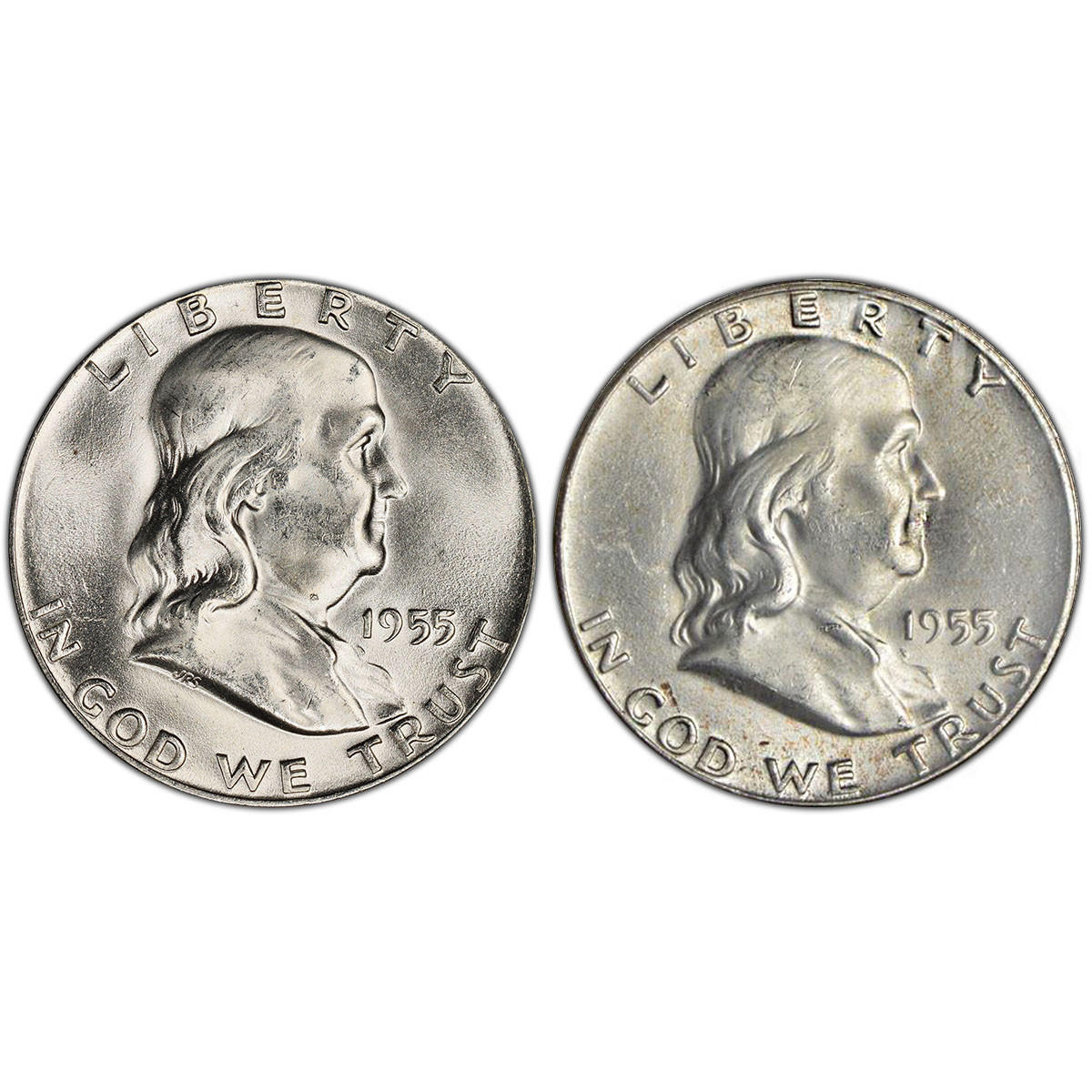
Group of 1955 Franklin Half Dollars showing different grades from circulated to uncirculated, Philadelphia Mint production
Issue Mint Mintage Notes
1955 Business Strike Philadelphia (no mint mark) 2,498,181 Lowest business-strike mintage in the Franklin series (1948–1963)
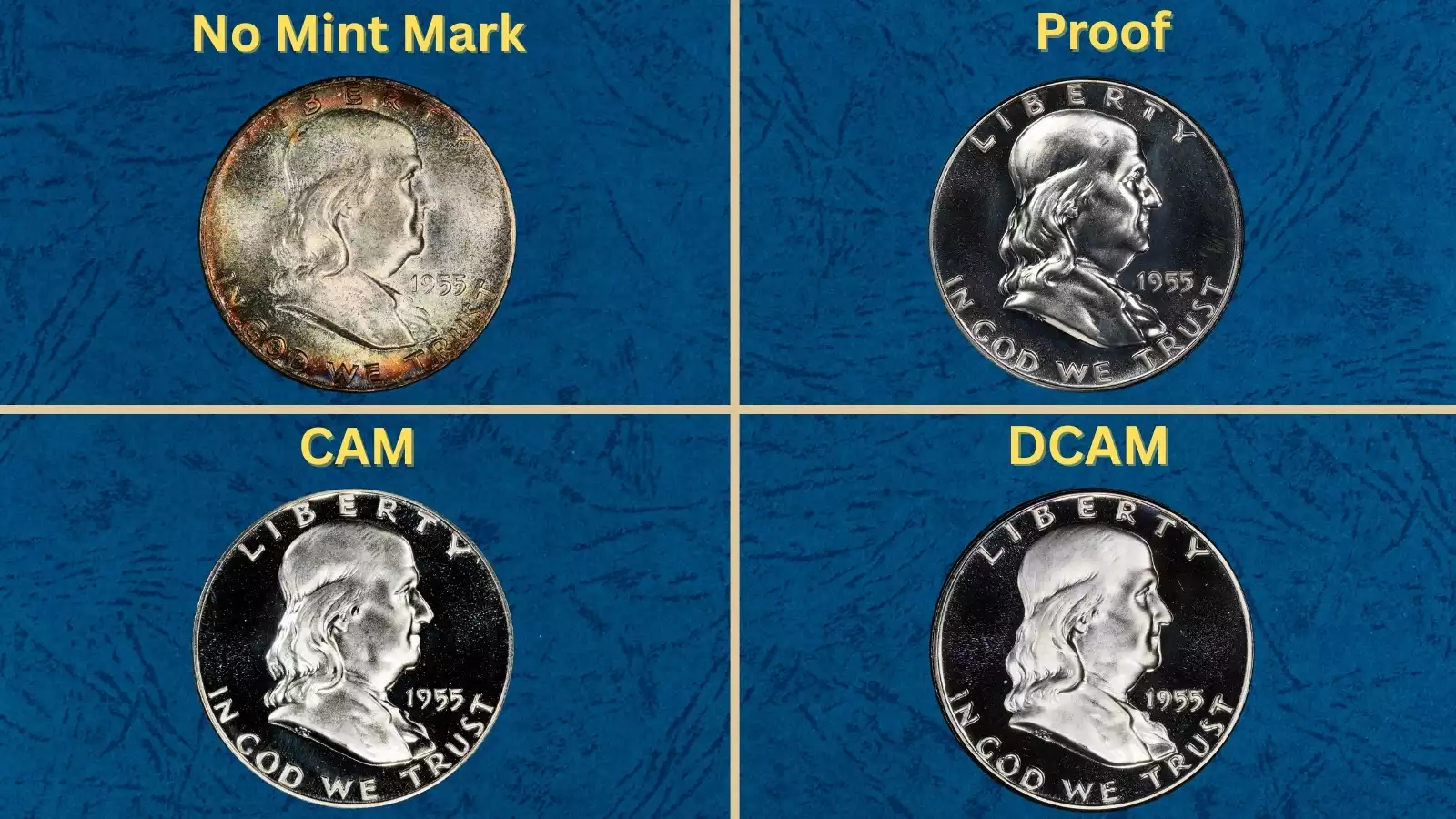
1955 Proof Philadelphia 378,200 First year of flat-pack annual sets; cameo/deep cameo proofs more common than earlier years
Total 1955 Philadelphia only 2,876,381 No Denver or San Francisco strikes in 1955
Survival note: Despite the low mintage, many uncirculated 1955 Franklin Half Dollars were saved by collectors who recognized the low production numbers at the time. This means MS-63 through MS-65 examples are available without great difficulty. Scarcity concentrates at MS-66 and above, and especially on FBL-designated pieces, where certified populations drop sharply. The 1955 proof run of 378,200 pieces is modestly sized, and problem-free cameo examples are worth seeking out.
Composition specs: 90% Silver · 10% Copper · 12.50 grams · 30.6 mm diameter · Reeded edge · Designer: John R. Sinnock (obverse and reverse) · 0.36169 troy oz actual silver weight

How to Grade Your 1955 Franklin Half Dollar

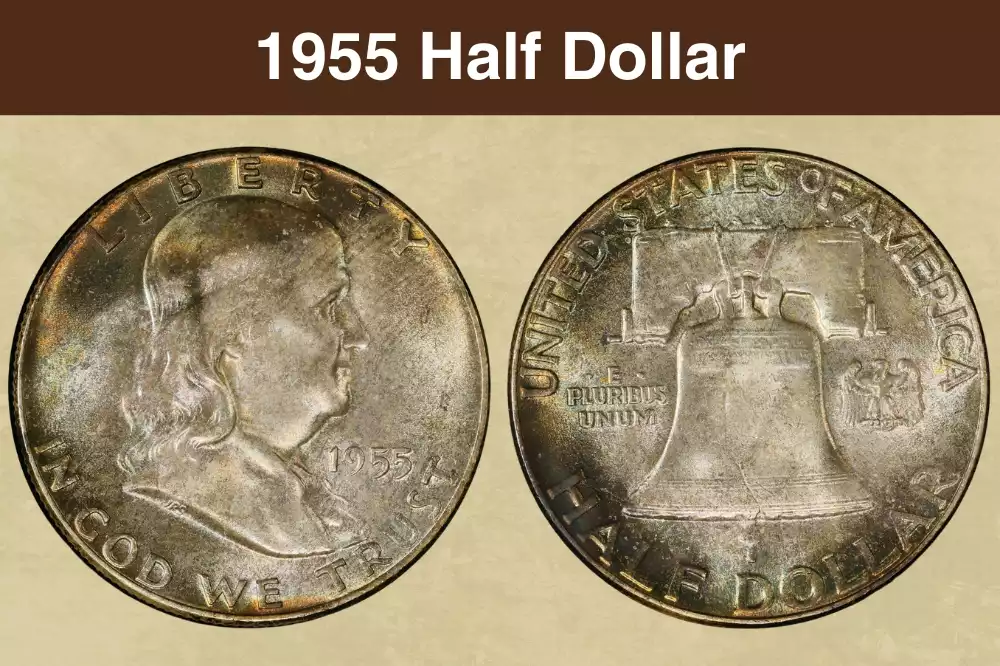
1955 Franklin Half Dollar grading strip showing four condition states: Good, Very Fine, About Uncirculated, and Mint State

Worn (G–VF)

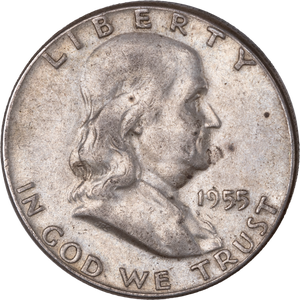
Moderate to heavy wear across Franklin's cheek, jaw, and hair details. The Liberty Bell lettering is visible but worn flat at the center. Bell lines at the base are mostly smooth. Most hair wisps behind the ear are merged. Value range: $18–$45 depending on exact grade and silver price.

Circulated (EF–AU)

Light wear visible on Franklin's cheek and the high points of hair above the ear. Bell lines are partially present but not complete. Mint luster survives in the recesses. AU-58 pieces with just a trace of high-point friction can be very attractive. Value: $30–$55.

Uncirculated (MS-63–64)

No wear — cartwheel luster intact across fields and devices. Bag marks visible in the fields and on Franklin's cheek. The bell lines may be partial or complete. A coin with moderate marks grades MS-63; fewer, lighter marks push toward MS-64. Value: $35–$120.

Gem (MS-65+)

Full luster with only minor contact marks — nothing distracting to the naked eye. The obverse fields are clean; Franklin's cheek shows minimal abrasion. Bell lines may still be partial (non-FBL) at MS-65. Adding FBL to MS-65 doubles or triples value. MS-66+ is genuinely scarce. Value: $80–$4,950+.

Pro tip — Full Bell Lines & the worn master die: The master hub used to produce working dies from 1955 through 1959 was notably worn. This means 1955 coins require exceptionally fresh working dies to achieve FBL. When examining an uncirculated 1955 half, check the bell lines first — if they are complete, you may have a coin worth several times the non-FBL value. Any single break in the lower lines disqualifies the FBL designation. Always examine under a 10× loupe in good lighting before concluding FBL status.

🔎 CoinKnow lets you compare your coin's surface details against certified graded examples to pinpoint its condition tier quickly — a coin identifier and value app.

Bugs Bunny FS-401 Self-Checker

The Bugs Bunny variety is the most-searched and most valuable common variety of the 1955 Franklin Half Dollar. Use this quick checker to see if your coin likely carries the FS-401 designation.

Side-by-side comparison of regular 1955 Franklin Half Dollar versus Bugs Bunny FS-401 variety showing the die clash spike at Franklin's upper lip

Regular 1955 Half Dollar

  • Franklin's lips are smooth and level — no protrusion
  • Upper lip line is clean with no raised spike or ridge
  • Normal eagle design on reverse — no clash marks in fields
  • Still collectible; valued for silver content and low mintage

Bugs Bunny FS-401 Variety

  • Raised spike or line projecting from Franklin's upper lip
  • Appears as protruding "buck teeth" — visible at 5×–10× magnification
  • Clash lines may also appear in the obverse fields near the mouth
  • Adds 20–60%+ premium in most grades; substantial premium in gem FBL

Check all features that match your coin:

Got a result from the Bugs Bunny checker? Now find out exactly what your coin is worth in dollars.

Calculate My Value →

Free 1955 Half Dollar Value Calculator

Select your coin's mint (Philadelphia only for 1955), condition, and any errors or special designations, then click Calculate.

This calculator works best if you already know your coin's condition and any error features. If you're unsure, there's a 1955 Franklin Half Dollar Coin Value Checker online tool that walks you through identification using photos before you estimate value.

Describe Your Coin for a Detailed Assessment

Type what you see on your coin below — our keyword analyzer will provide a tailored assessment based on your description.

Mention these things if you can

  • Overall luster (bright, dull, toned)
  • Visible wear on Franklin's cheek or hair
  • Anything unusual at Franklin's lips or mouth area
  • Condition of the Liberty Bell lines on the reverse
  • Any missing metal at the coin's edge

Also helpful

  • Significant contact marks or bag marks
  • Any toning (rainbow, blue, golden)
  • Whether you can see ghost impressions in the fields
  • Any professional grading holder information
  • Where the coin came from (collection, circulation, bank roll)

Where to Sell Your Valuable 1955 Franklin Half Dollar

The right venue depends on your coin's grade and variety. High-grade FBL and Bugs Bunny specimens deserve auction exposure; common circulated examples are better suited to direct buyers.

🏛️ Heritage Auctions

The top venue for MS-65+ FBL and Bugs Bunny FS-401 examples. Heritage reaches the deepest pool of Franklin specialists and has set the all-time record for the 1955 issue at $14,100. Expect 15–20% buyer's premium; consignment minimums apply for lower-value coins. Best for any coin likely grading MS-66 or higher, or with both FBL and Bugs Bunny together.

🛒 eBay

Ideal for circulated, MS-63, and MS-64 examples without special designations. Check recently sold prices for 1955 Franklin Half Dollars on completed eBay listings to price your coin competitively. PCGS or NGC certified coins sell faster and for higher prices than raw (uncertified) examples, even in the same grade range.

🏪 Local Coin Shop

Provides instant payment and requires no shipping or listing effort. Expect dealer bids of 60–75% of retail for circulated examples — dealers need margin to resell. If you have a high-grade or variety coin, get at least two dealer quotes. Local shops are excellent for worn examples where auction fees would eat into net proceeds.

💬 Reddit r/Coins4Sale & Collector Forums

The r/Coins4Sale and NumismaticForum communities allow direct collector-to-collector sales with no buyer's premium. Fees are minimal but you'll need a solid reputation (karma/feedback). Best for mid-grade MS-63 to MS-65 examples where you can educate a buyer about the 1955's low mintage. Certified coins are preferred; raw coins require extra trust-building.

💡 Get it graded first: If your 1955 Franklin Half Dollar appears to be MS-65 or higher, or shows both the Bugs Bunny FS-401 variety and Full Bell Lines, the cost of PCGS or NGC certification ($30–$80 per coin depending on service level) is almost always recovered in the sale price premium. Certified coins on Heritage and eBay routinely sell for 30–80% more than equivalent raw coins, and the variety designations (FBL, FS-401) only appear on certified holders.

Frequently Asked Questions — 1955 Half Dollar Value

  • How much is a 1955 Franklin Half Dollar worth?
    A worn 1955 Franklin Half Dollar is typically worth $18–$25 in circulated grades based on its 90% silver content and collector demand. In uncirculated MS-63 condition, expect $35–$55. Gem MS-65 examples bring $80–$110. The big premiums come with Full Bell Lines (FBL) designation, where MS-65 FBL pieces sell for $80–$150, and the Bugs Bunny FS-401 variety adds a further premium. The record sale for a single specimen is $14,100 for an MS-67 FBL example sold by Heritage Auctions.
  • What is the Bugs Bunny 1955 Half Dollar?
    The Bugs Bunny variety (PCGS FS-401) is a die clash error where the obverse and reverse dies struck each other without a planchet between them. This transferred the impression of the eagle's wing feather tips onto Franklin's upper lip area, creating the appearance of two protruding buck teeth. It is estimated that roughly 1–2% of the 2,498,181 business-strike mintage shows this characteristic, making it relatively common as error varieties go but still commanding a premium of 20–60% over a regular 1955 half in comparable grades.
  • What does Full Bell Lines (FBL) mean on a 1955 Half Dollar?
    Full Bell Lines refers to the presence of complete, uninterrupted horizontal lines across the bottom of the Liberty Bell on the reverse. Because die wear and bag marks frequently obliterate these fine lines, FBL-designated coins are scarcer and more valuable. On a 1955 Franklin Half, the worn master die used from 1955–1959 means FBL strikes are especially elusive; an MS-65 FBL 1955 half can sell for two to three times the price of a non-FBL example in the same grade. PCGS designates this with the FBL suffix.
  • How many 1955 Franklin Half Dollars were minted?
    The Philadelphia Mint struck 2,498,181 business-strike 1955 Franklin Half Dollars, plus an additional 378,200 proof coins. 1955 is the lowest-mintage business-strike date in the entire Franklin Half Dollar series (1948–1963). Only the Philadelphia Mint produced halves this year; neither the Denver nor San Francisco Mints struck any half dollars dated 1955.
  • Is the 1955 Franklin Half Dollar a key date?
    The 1955 Franklin Half is considered a semi-key date. Its mintage of just under 2.5 million is the lowest in the series, which does add a small premium over common-date Franklins in all grades. However, many uncirculated examples were saved early, so the coin is not rare in MS-63 through MS-65. The real scarcity emerges at MS-66 and above, and especially for FBL-designated pieces, where population figures drop sharply and prices rise significantly.
  • What is the silver melt value of a 1955 Half Dollar?
    The 1955 Franklin Half Dollar contains 0.36169 troy ounces of pure silver (90% silver, 10% copper composition, 12.5 grams total weight). The silver melt value fluctuates daily with the spot price of silver. At a silver price of approximately $30 per troy ounce, the melt value is roughly $10.85 per coin. At $35 silver, melt value approaches $12.66. Any collector premium on top of melt value depends entirely on the coin's condition and variety. Even worn examples often sell for well above melt due to collector demand.
  • How do I tell if my 1955 Half Dollar has Full Bell Lines?
    Flip the coin to the reverse and focus on the lower portion of the Liberty Bell, just above the crack. You will see a series of thin horizontal lines running across the bell. On a Full Bell Lines coin, all lines in the bottom two rows are complete and unbroken from one side to the other with no gaps. Under a 10× loupe, each line should be sharply defined. A single break in any line disqualifies the FBL designation. The lines closest to the bottom of the bell are the first to fade on weakly struck or bag-worn examples.
  • What is the most valuable 1955 Franklin Half Dollar ever sold?
    The highest recorded auction price for a regular-strike 1955 Franklin Half Dollar is $14,100, achieved by an MS-67 Full Bell Lines example sold through Heritage Auctions in January 2016 (PCGS-certified). This coin represented the finest-known combination of grade and FBL designation at the time. Non-FBL examples in MS-67 have sold for over $5,000. The Bugs Bunny FS-401 variety in high MS-66 FBL condition has reached $1,500–$5,000 at auction depending on the strike strength and eye appeal.
  • Is there a proof 1955 Franklin Half Dollar?
    Yes. The Philadelphia Mint produced 378,200 proof 1955 Franklin Half Dollars, packaged in the new flat-pack annual sets introduced that year. Proof coins show mirror-like fields and frosted devices. Cameo and deep cameo finishes are more common on 1955 proofs than on earlier Franklin proofs due to improving production quality. A problem-free 1955 proof in PR-65 grade typically sells for $100–$130. Cameo examples command higher premiums, and certified Deep Cameo specimens in PR-67 or higher can sell for several hundred dollars.
  • Where is the mint mark on a 1955 Franklin Half Dollar?
    The 1955 Franklin Half Dollar was struck exclusively at the Philadelphia Mint. Philadelphia-minted coins from this era carry no mint mark — you will not find a 'P', 'D', or 'S' on any 1955 Franklin Half Dollar business strike. The mint mark on Franklin Half Dollars, when present, appears on the reverse above the Liberty Bell beam. If you see a 1955 half with a mint mark, re-examine the date; Denver and San Francisco minted no half dollars in 1955.

Ready to Find Out What Your 1955 Half Dollar Is Worth?

Use our free calculator — no signup, no email, instant results based on real auction data.

Calculate My Coin's Value Now →